Introduction
Solar panels are devices that turn sunlight into electricity. They sit on rooftops, in solar farms, and on commercial buildings, quietly producing clean energy every day. But a solar panel is not just one solid piece. It is built from several carefully engineered solar panel components that work together as a system.
Understanding these components is important for everyone. Homeowners want reliable panels that last 25 years or more. EPC companies need high-efficiency modules for large projects. OEM buyers look for advanced manufacturing and durable materials. The quality of each component directly affects performance, safety, and long-term energy output.
Modern panels now use advanced technologies such as TOPCon solar cells, 24 busbar (24BB) design, glass-to-glass modules, and larger 230mm wafers. In this complete guide, you will learn what each solar panel component does, how they are assembled, and why manufacturing quality matters.
What Are Solar Panel Components?
Solar panel components are the individual parts that make up a photovoltaic (PV) module. Each layer has a specific function: some convert sunlight into electricity, some protect the internal structure, and others manage electrical output.
A typical solar panel includes:
- Solar cells
- Tempered glass
- EVA encapsulation layers
- Backsheet or rear glass
- Aluminum frame
- Junction box
- Busbars and ribbon connectors
Basic Working Principle
Solar panels work using the photovoltaic effect. When sunlight hits the solar cells, it excites tiny particles called electrons. These moving electrons create direct current (DC) electricity. This DC power then flows through wires to an inverter, which converts it into usable alternating current (AC) for homes and businesses.
Every component plays a role in protecting the cells and ensuring maximum energy conversion.
Main Components of a Solar Panel (Core Structure)
1. Solar Cells (The Heart of the Panel)
Solar cells are the most important solar panel component. They are responsible for converting sunlight into electricity.
There are two main types:
- Monocrystalline solar cells – Higher efficiency, darker color, better performance in low light.
- Polycrystalline solar cells – Slightly lower efficiency, lower cost.
Modern manufacturing now focuses on advanced cell technologies:
- PERC (Passivated Emitter Rear Cell)
- TOPCon (Tunnel Oxide Passivated Contact)
TOPCon solar cells offer higher efficiency and lower degradation compared to traditional PERC cells. They perform better over time and generate more electricity from the same sunlight.
230mm Wafer Technology
Larger wafers, such as 230mm, allow more surface area for sunlight absorption. This increases module wattage and improves output per panel.
24BB (24 Busbar) Technology
Busbars are thin metallic strips that collect electricity from solar cells. Traditional panels used 9 or 12 busbars. Modern panels use 24BB technology, which:
- Reduces electrical resistance
- Improves current collection
- Enhances durability
- Increases efficiency
The result is better long-term energy production.
2. Solar Glass (Front Layer Protection)
The front of the solar panel is covered with tempered solar glass. This glass is strong and impact-resistant. It protects internal components from:
- Rain
- Dust
- Snow
- Wind
- Hail
Most solar glass includes an anti-reflective coating. This coating reduces sunlight reflection and allows more light to reach the solar cells. Even a small increase in light absorption can improve total energy output over time.
3. EVA (Encapsulation Layer)
EVA stands for Ethylene Vinyl Acetate. It is a transparent material placed above and below the solar cells.
Its functions include:
- Protecting cells from moisture
- Holding cells firmly in place
- Absorbing vibrations
- Providing electrical insulation
Without proper EVA encapsulation, panels may suffer from delamination or moisture damage.
4. Backsheet (or Rear Glass in Glass-to-Glass Modules)
The backsheet is the rear protective layer of a solar panel. It protects the internal structure from environmental exposure and provides electrical insulation.
Common types include:
- TPT (Tedlar-Polyester-Tedlar)
- Composite backsheets
However, modern glass-to-glass solar modules replace the backsheet with another layer of glass. This design improves:
- Durability
- Resistance to moisture
- Mechanical strength
- Long-term performance
Glass-to-glass modules typically have lower degradation rates and longer lifespans.
5. Aluminum Frame
The aluminum frame surrounds the solar panel and provides structural strength. It:
- Protects panel edges
- Helps with mounting
- Withstands wind load
- Prevents physical damage
Aluminum is lightweight and corrosion-resistant, making it ideal for outdoor use.
6. Junction Box
The junction box is attached to the back of the panel. It manages electrical output and connects the panel to external wiring.
It contains bypass diodes that:
- Prevent overheating
- Reduce power loss from shading
- Improve safety
A high-quality junction box ensures stable and safe performance.
7. Busbars and Ribbon Connections
Busbars collect electricity generated by solar cells. Ribbon connectors link the cells together in a series.
More busbars mean:
- Lower resistance
- Better current flow
- Higher reliability
24BB solar modules outperform traditional designs in efficiency and durability.
Additional Components in Modern Solar Panels
Modern photovoltaic modules include additional materials for improved performance:
- Bypass diodes
- MC4 connectors
- Edge sealing materials
- PID-resistant layers
- Industrial-grade sealants
These small but critical components enhance system safety and longevity.
Layer-by-Layer Structure of a Solar Panel
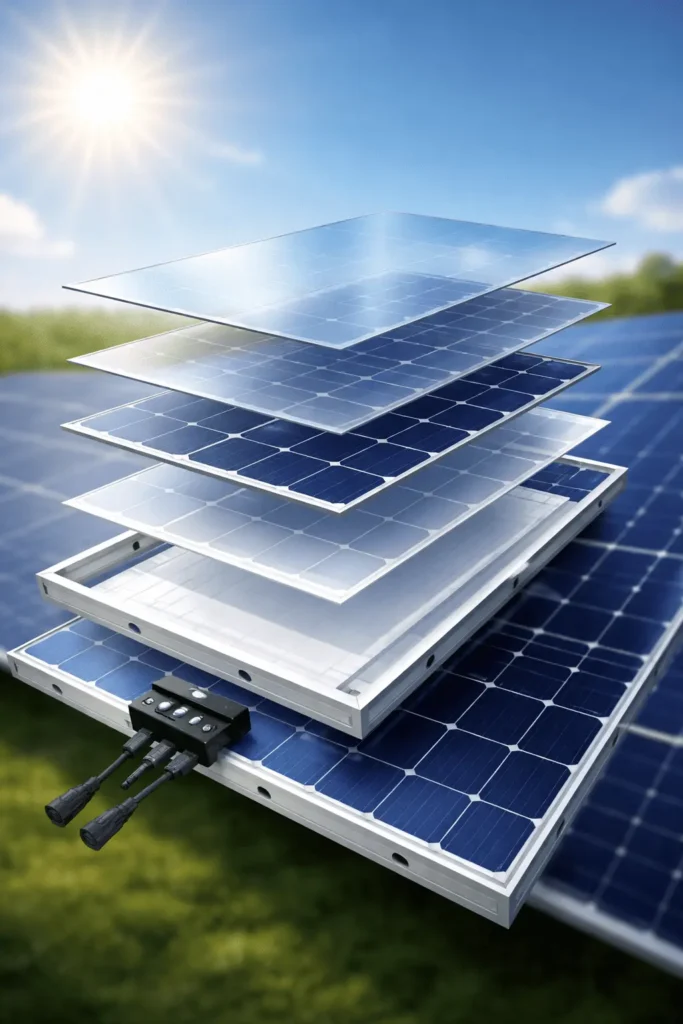
A typical solar panel structure looks like this:
- Tempered glass
- EVA layer
- Solar cells
- EVA layer
- Backsheet or rear glass
- Aluminum frame
- Junction box
Each layer has a defined purpose. Together, they create a strong, weather-resistant energy system.
How Solar Panel Components Work Together
When sunlight hits the tempered glass, it passes through to the solar cells. The cells generate DC electricity. Busbars collect this electricity and send it to the junction box. The junction box transfers power to external cables.
At the same time:
- EVA protects the cells.
- The backsheet or rear glass seals the structure.
- The frame ensures mechanical stability.
Efficiency depends on cell quality, light absorption, electrical resistance, and manufacturing precision.
Advanced Technologies in Solar Panel Components
TOPCon Cell Technology
TOPCon improves efficiency by reducing electron recombination inside the cell. Compared to PERC:
- Higher efficiency
- Better temperature performance
- Lower annual degradation
This means more electricity over the panel’s lifetime.
24BB Technology
24 busbar technology distributes current evenly across the cell surface. It:
- Reduces energy loss
- Minimizes microcrack impact
- Enhances reliability
Glass-to-Glass Module Design
Using dual glass layers increases:
- Weather resistance
- Structural strength
- Lifespan
These modules are ideal for harsh climates and utility-scale projects.
230mm Wafer Technology
Larger wafers increase power output per module. Higher wattage panels reduce installation costs and improve system efficiency.
Solar Panel Manufacturing Process (Component Integration)
High-quality solar panel manufacturing involves precise automation.
Key stages include:
- Cell sorting for efficiency grading
- Stringing cells together
- Layup of glass, EVA, and cells
- Lamination under controlled heat
- Framing
- Junction box installation
- EL testing to detect microcracks
- Flash testing for output verification
Automation ensures consistent quality and minimal defects.
Quality Factors That Impact Solar Panel Components
Several factors influence panel reliability:
- High-grade raw materials
- Advanced automation
- Strict quality control
- International certifications
- Low degradation rate
Manufacturing excellence directly affects panel lifespan and return on investment.
Common Problems Related to Solar Panel Components
Understanding potential issues helps in prevention.
- Microcracks – Caused by stress or poor handling
- Delamination – Poor EVA bonding
- PID (Potential Induced Degradation) – Electrical imbalance
- Hotspots – Shading or faulty cells
- Backsheet cracking – Material aging
- Junction box failure – Poor sealing
High manufacturing standards reduce these risks.
How to Choose High-Quality Solar Panel Components
For EPC companies and B2B buyers, consider:
- Cell type (TOPCon preferred)
- Busbar count (higher is better)
- Glass thickness
- Frame strength
- Warranty period
- Factory automation
- Production capacity
Reliable manufacturers invest in testing, R&D, and advanced technology.
Solar Panel Components for Utility vs Residential Projects
| Feature | Residential | Utility-Scale |
|---|---|---|
| Efficiency | High | Very High |
| Durability | Standard | Enhanced |
| Cost | Balanced | Optimized for scale |
| Lifespan | 25+ Years | 30+ Years |
| Technology | Mono / PERC | TOPCon / Glass-to-Glass |
Utility projects often demand advanced N-type and bifacial modules.
Future of Solar Panel Components
The solar industry continues to evolve.
- N-type solar cells are replacing P-type.
- Higher busbar counts improve efficiency.
- Bifacial modules capture sunlight from both sides.
- AI-driven manufacturing improves quality control.
- Integration with hydrogen energy systems is emerging.
Innovation in solar panel components will continue to increase efficiency and reliability.
Want to See How Premium Components Translate to Real Performance?
Powersphere’s Suryatop uses G12R half-cut N-Type TOPCon cells with 24 busbar technology, IP68 junction box, and dual-tempered glass – the same components described in this guide, assembled to achieve up to 23.51% module efficiency.
The Agnitop uses M10 cells with identical component quality, reaching 23.60% efficiency. Both manufactured at Salem, Tamil Nadu with ATW K-series automated stringers and multi-stage EL testing.
FAQs
Solar cells, glass, EVA, backsheet or rear glass, frame, junction box, and busbars.
Solar cells have the biggest impact on efficiency.
EVA is a protective encapsulation layer that shields cells from moisture and vibration.
High-quality components can last 25 to 30 years or more.
Yes, they offer better durability and lower degradation in harsh environments.
Conclusion
Solar panel components are not just parts; they are a carefully engineered system. From solar cells to junction boxes, each layer plays a critical role in energy generation, safety, and durability.
Advanced technologies such as TOPCon cells, 24BB design, glass-to-glass modules, and 230mm wafers are shaping the future of solar energy. For homeowners, EPC companies, and OEM buyers, understanding these components helps in selecting reliable, high-performance solar modules.
Choosing a manufacturer that prioritizes material quality, automation, and innovation ensures long-term returns and sustainable energy production.