
Before installing a solar system at home, one of the most important questions is: “How many units will my solar panels generate?” Calculating the output correctly helps you choose the right system size, estimate savings, and avoid underperformance.
In this guide, we’ll show you step-by-step how to calculate solar panel output for residential systems in India, including real examples and tips to maximize energy generation.
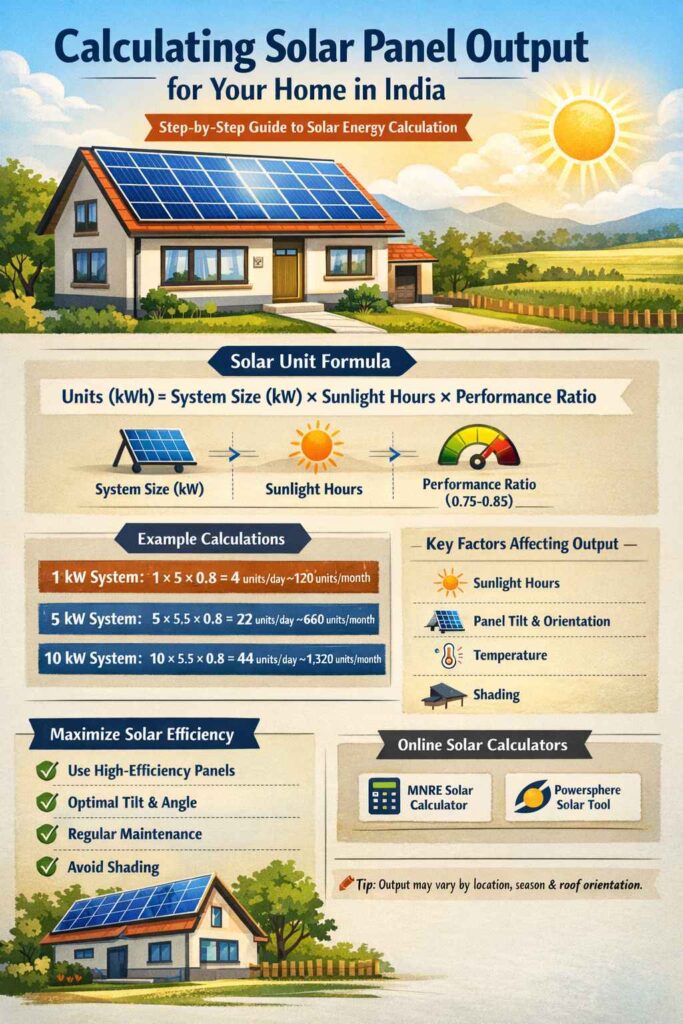
Understanding Solar Panel Output
Solar panel output refers to the electricity your panels generate, measured in kilowatt-hours (kWh), also called units.
Key points to understand:
- Panel wattage vs system output: A 550 W panel does not produce 550 kWh per day. Output depends on sunlight and efficiency.
- Factors affecting output: Sunlight hours, panel tilt and orientation, temperature, and system efficiency.
Step-by-Step Solar Unit Calculation for Residential Systems
Solar Unit Formula
To calculate the units generated:
Units (kWh) = System Size (kW) × Average Sunlight Hours × Performance Ratio (Efficiency)
- System Size (kW): Total installed capacity of your solar panels
- Sunlight Hours: Average peak sun hours per day in your location
- Performance Ratio: Accounts for losses (typically 0.75–0.85)
Example 1: 1 kW Residential System
- Average sunlight: 5 hours/day
- Performance ratio: 0.8
1 × 5 × 0.8 = 4 units/day
➡️ ~120 units/month
➡️ ~1,460 units/year
Example 2: 5 kW Residential System
- Average sunlight: 5.5 hours/day
- Performance ratio: 0.8
5 × 5.5 × 0.8 = 22 units/day
➡️ ~660 units/month
➡️ ~7,900 units/year
Example 3: 10 kW Residential System
- Average sunlight: 5.5 hours/day
- Performance ratio: 0.8
10 × 5.5 × 0.8 = 44 units/day
➡️ ~1,320 units/month
➡️ ~15,800 units/year
📌 Tip: Your actual output may vary based on roof orientation, dust, shading, and temperature.
Online Tools & Calculators
For precise calculations, you can use solar output calculators. Some trusted options in India:
- MNRE solar calculator
- Powersphere Solar Output Calculator (link to commercial/residential contact page)
- Third-party calculators like SolarReviews and CleanTechnica tools
These calculators allow you to input your roof size, location, and panel type to get more accurate results.
Seasonal Variations & Regional Differences
India has wide regional differences in sunlight:
| Region | Avg Sunlight Hours | Seasonal Notes |
|---|---|---|
| Tamil Nadu | 5–5.5 | Stable year-round |
| Rajasthan | 6–6.5 | Excellent summer generation |
| North India | 4–5 | Winter months have lower output |
| Coastal Areas | 4.5–5 | Humidity may reduce efficiency slightly |
📌 Tip: Use average sunlight for calculations and adjust for seasonal variations.
Tips to Maximize Residential Solar Output
- Choose high-efficiency solar panels – More energy per panel, ideal for limited roof space
- Optimal tilt and orientation – South-facing panels in India maximize sunlight absorption
- Regular maintenance – Dust and dirt can reduce output by 5–20%
- Inverter quality matters – Reliable inverters minimize energy loss
- Shading analysis – Avoid shadows from trees or neighboring buildings
Linking to Further Guidance
- Learn more about solar panel unit generation in India: Solar Panel Unit Generation
- Explore commercial solar solutions: Commercial Solar Panels
FAQ
About 120–150 units/month, depending on location and season.
Yes. Use the formula: kW × Sunlight hours × Efficiency.
Absolutely. South-facing roofs are ideal in India; east/west reduce generation by ~10–15%.
Final Thoughts
By calculating solar panel output before installation, you ensure that your residential system is sized correctly and maximizes electricity generation. With proper panel selection, orientation, and maintenance, you can enjoy reliable, sustainable energy for your home.