
Understanding solar panel unit generation is one of the most important steps before installing a solar power system. Whether you are a homeowner planning rooftop solar or a business evaluating a large commercial plant, knowing how many electricity units (kWh) your system can generate helps you size your system correctly, estimate savings, and avoid under- or over-investment.
In this guide, we explain how solar unit generation works in India, how it is calculated, real-world examples by system size, and how to maximize output using the right solar panels and system design.
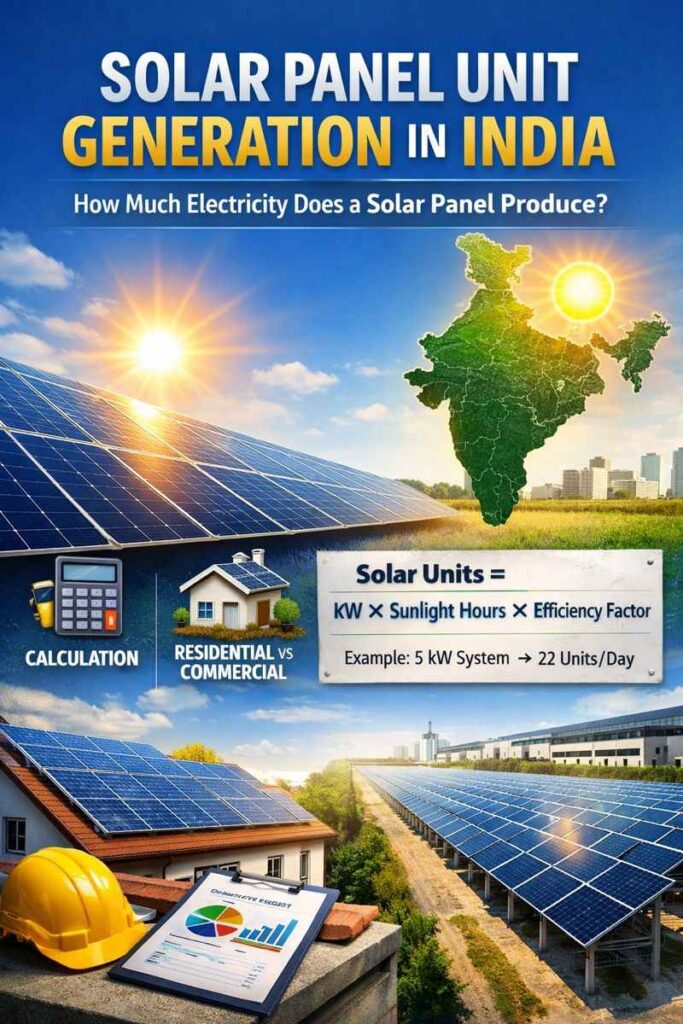
What Does “Solar Panel Unit Generation” Mean?
In simple terms, solar panel unit generation refers to the amount of electricity produced by a solar panel or solar system over a specific time period.
- 1 unit = 1 kilowatt-hour (kWh)
- If a solar system produces 10 kWh in a day, it generates 10 units of electricity
Common Measurement Periods
- Per day (kWh/day)
- Per month (kWh/month)
- Per year (kWh/year)
Panel Output vs System Output
- Panel output: Capacity of a single panel (e.g., 550W)
- System output: Combined generation of all panels + inverter efficiency + site conditions
👉 In real installations, system-level generation matters more than individual panel wattage.
How Solar Panel Unit Generation Is Calculated (Formula)
This is the most important concept for understanding solar generation.
Standard Solar Unit Generation Formula
Solar Units (kWh) = System Size (kW) × Average Sunlight Hours × Performance Ratio
Where:
- System Size = Total installed capacity (kW)
- Sunlight Hours = Average daily peak sun hours
- Performance Ratio (PR) = 0.75–0.85 (accounts for losses)
Example Calculation (India)
For a 5 kW solar system:
- Average sunlight hours: 5.5 hours/day
- Performance ratio: 0.8
5 × 5.5 × 0.8 = 22 units/day
➡️ ≈ 660 units/month
➡️ ≈ 7,900 units/year
Solar Panel Unit Generation Per Day in India
India is one of the best regions globally for solar power due to high solar irradiance.
Average Sunlight Hours in India
- 4.5 to 6.5 peak sun hours/day
- National average: 5–5.5 hours/day
Regional Variation
- Rajasthan, Gujarat, Tamil Nadu: Higher generation
- North India: Seasonal winter dip
- Coastal areas: Slight humidity losses, manageable with maintenance
Seasonal Impact
- Summer: Higher units
- Monsoon: Reduced output (10–25%)
- Winter: Stable but lower sun hours in northern states
Solar Unit Generation by System Size (India)
| System Size | Daily Units | Monthly Units | Annual Units |
|---|---|---|---|
| 1 kW | 4–5 units | 120–150 | 1,500–1,800 |
| 3 kW | 12–15 units | 360–450 | 4,500–5,400 |
| 5 kW | 20–25 units | 600–750 | 7,500–9,000 |
| 10 kW | 40–50 units | 1,200–1,500 | 15,000–18,000 |
| 100 kW (Commercial) | 400–500 units | 12,000–15,000 | 1.5–1.8 lakh |
⚠️ Actual generation depends on design, panel quality, and maintenance.
Factors Affecting Solar Panel Unit Generation
1. Solar Panel Efficiency
Higher efficiency panels convert more sunlight into electricity—especially critical when roof space is limited.
2. Tilt Angle & Orientation
- Ideal tilt: Latitude ±10°
- South-facing orientation (India) delivers maximum output
3. Temperature Loss
High temperatures reduce voltage. Advanced cell technology minimizes this loss.
4. Dust & Soiling
India’s dusty environment can reduce generation by 5–20% without regular cleaning.
5. Inverter & Electrical Losses
Poor-quality inverters and cabling reduce usable output.
Residential vs Commercial Solar Unit Generation
Residential Solar
- Smaller systems (1–10 kW)
- Focus on self-consumption
- Limited roof area
- Net metering plays a key role
Commercial & Industrial Solar
- Larger systems (50 kW–5 MW)
- Optimized for maximum generation
- Flat roofs / ground-mounted plants
- Higher ROI through scale and load matching
👉 Commercial systems benefit significantly from high-quality manufacturing and advanced module technology.
How to Increase Solar Panel Unit Generation
- Use high-efficiency solar panels
- Optimize system design and layout
- Ensure proper tilt and shadow-free installation
- Choose reliable inverters
- Perform regular cleaning and inspection
- Source panels from a trusted solar panel manufacturer
Choosing the Right Solar Panels for Maximum Unit Generation
Not all solar panels generate the same real-world units—even if wattage looks similar on paper.
Why Manufacturing Quality Matters
- Cell uniformity impacts performance
- Advanced technologies reduce degradation
- Precision automation ensures consistent output
At Powersphere Renewable Pvt Ltd, our modules are designed for high unit yield, durability, and Indian operating conditions—making them ideal for both residential and large commercial projects.
👉 Explore our How To Calculate SolarPanel Output
👉 Learn more about our Solar Panel Manufacturing Company in India
Frequently Asked Questions (FAQ)
On average, 1 kW solar generates 4–5 units per day in India.
You need approximately a 7–8 kW solar system, depending on location and efficiency.
Yes. Higher efficiency panels generate more units from the same roof area, especially in commercial installations.
Final Thought: Install Solar With Clarity, Not Assumptions
Understanding solar panel unit generation helps you:
- Size systems correctly
- Estimate savings accurately
- Maximize long-term ROI
For a detailed breakdown of daily unit output by city and system size, see our complete guide: How Many Units Does a Solar Panel Produce Per Day in India?
Whether you’re planning a rooftop system or a multi-MW project, choosing the right panels and manufacturing partner makes all the difference.
View Commercial Solar Panels
Partner with a Trusted Solar Panel Manufacturer in India